1 min read
Employed and self-employed at the same time
Your job's payroll handles tax on your salary, but not on your side income. Here's how the two fit together on one tax return.
In short
Lots of people have a payroll job and self-employed income. Your employer deducts tax and NI from your salary through PAYE. Your side income isn't taxed until you report it on a Self Assessment return. Because your salary normally uses up your tax-free allowance, your side profit is usually taxed from the first pound.
How it works
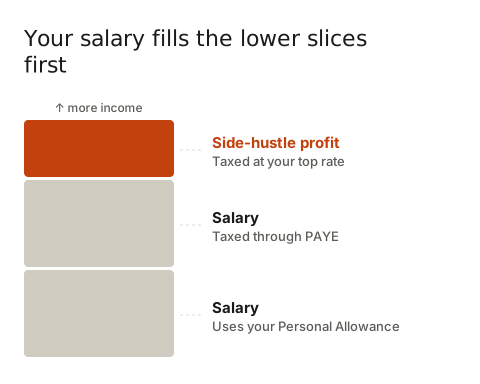
Income Tax works in slices. Your salary fills them from the bottom, and your side-hustle profit sits on top. If your salary already reaches the higher band, your side profit is taxed at the higher rate. Plan your tax pot on that basis.
On your return, you report your job using the figures from your P60 (or P45 if you left) and your self-employment separately. HMRC then works out the total and deducts what PAYE already took.
If the extra you owe is fairly small and you file online early enough, you can often ask for it to be collected through your tax code the following year, rather than paying a lump sum. Check GOV.UK for the current limit and cut-off date.
An example
Fatima works full time as a nurse and runs a weekend photography business. Her salary already uses her Personal Allowance and some of the basic-rate band. Her photography profit is taxed at the basic rate from the first pound. She sets aside a share of every booking fee.
Common mistakes
- Assuming PAYE 'covers everything'. It only covers what your employer pays you.
- Forgetting National Insurance on your side profits.
- Checking your employment contract too late. Some restrict outside work.
Your next step: find your latest payslip and see which tax band your salary reaches. That's the rate to use for your side income.