1 min read
How Income Tax bands really work
Moving into a higher band doesn't make all your income taxed more. Only the slice above the line is.
In short
Income Tax works in slices, called bands. The first slice is tax-free (your Personal Allowance). The next is taxed at the basic rate, the next at the higher rate, and so on. When your income crosses into a higher band, only the part above the line is taxed at the higher rate.
How it works
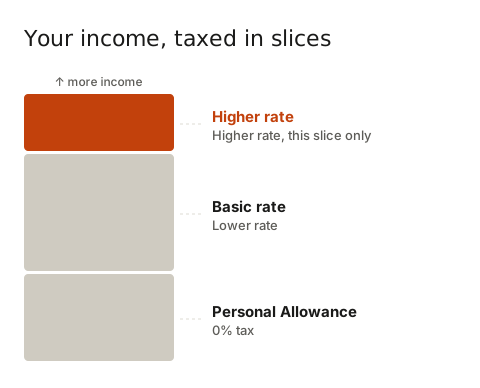
Your self-employed profit is added to any other income, like a salary, pension or rent. The total then fills the slices from the bottom up. If you also have a job, your salary usually uses up the lower slices first. That's why side income can land in a higher band. See Employed and self-employed at the same time.
A few things worth knowing:
- Scotland sets its own Income Tax bands and rates on earnings. The idea of slices is the same.
- At very high incomes, the Personal Allowance is gradually withdrawn, which creates a steep effective rate on one slice.
- Paying into a pension can effectively move income out of a higher slice. See Pensions for the self-employed.
- Band thresholds and rates are set by government and can change. Check GOV.UK each year.
An example
Hannah's income goes just over the line into the higher band. Her friend warns that she'll 'pay higher rate on everything'. That's not true. Only the few hundred pounds above the line are taxed at the higher rate. Everything below is taxed exactly as before.
Common mistakes
- Turning down work to 'avoid going into a higher band'. You always keep more by earning more.
- Forgetting that National Insurance has its own, separate thresholds. See National Insurance for the self-employed.
- Using rest-of-UK rates if you live in Scotland.
Your next step: look up this year's bands for where you live and note roughly which slice your next pound of profit falls into. That's your rate for planning.