1 min read
National Insurance for the self-employed
National Insurance is paid on profits above a threshold, and it builds your State Pension record. Low earners may want to pay voluntarily.
In short
As well as Income Tax, the self-employed pay National Insurance (NI) on profits above a set threshold. It's worked out and collected through your Self Assessment return, so there's no separate bill. Crucially, it builds your NI record, which decides how much State Pension you'll get.
How it works
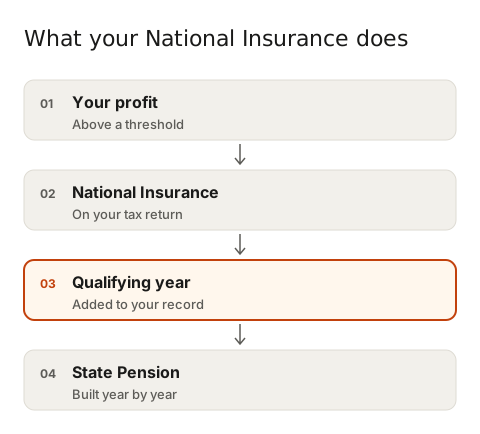
NI uses its own thresholds, separate from Income Tax bands. For the self-employed, the main contributions are a percentage of profit between a lower and upper limit, with a smaller rate above that. The rates, the thresholds and even the classes of contribution have changed over the years. Check GOV.UK for the current set-up.
Each year you pay enough NI, or are credited with it, counts as a qualifying year. You need a certain number of qualifying years to get any State Pension, and more for the full amount.
If your profits are low, you might not pay NI automatically. You may then be able to pay voluntary contributions to fill the gap. They're often good value for protecting your State Pension.
An example
Ravi had a quiet first year and made a small profit, below the NI threshold. He checks his NI record online and sees a gap for that year. He pays a modest voluntary contribution to turn it into a qualifying year.
Common mistakes
- Forgetting NI when setting money aside. Your tax pot should cover both.
- Assuming a salaried job's NI covers your side income too. They're worked out separately.
- Never checking your NI record until retirement, when gaps may be too old to fill.
Your next step: check your National Insurance record on GOV.UK or in the HMRC app. Look for gaps, and read Pensions for the self-employed.