1 min read
Buying equipment: how the tax relief works
Laptops, tools and machinery can reduce your tax. Depending on your accounting method, you either deduct them as expenses or claim capital allowances.
In short
Equipment you buy for the business, such as a laptop, a camera, tools or a van, can reduce your taxable profit. How you claim depends on your accounting method. On cash basis, most equipment is simply treated as an expense. On traditional accounting, you claim capital allowances, which often give full relief in the year of purchase too.
How it works
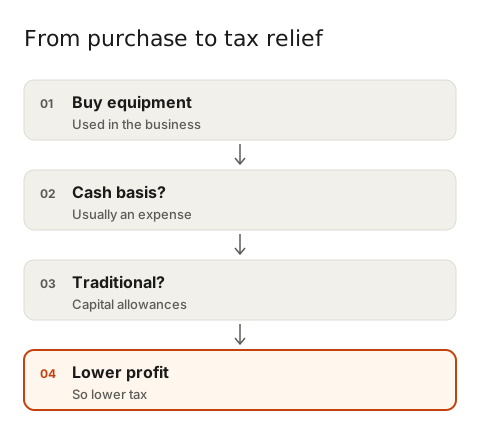
Capital allowances are HMRC's way of giving tax relief on long-lasting items. The main one for small businesses lets you deduct the full cost of most equipment in the year you buy it, up to a generous yearly limit. Other allowances spread the cost over several years.
Cars are the main exception. You can't usually deduct a car's full cost upfront. Relief is spread over time and depends on its emissions. Or you use the flat mileage rate instead, which already includes an allowance for the car's cost. Vans are often treated more generously than cars.
If you use an item personally too, claim only the business share. If you later sell it, you may need to account for the sale in your profit.
An example
Isaac, a video editor on cash basis, buys a new computer used only for work. He records it as an expense in the year he pays for it, which lowers that year's profit. If he used it half for gaming, he'd claim half.
Common mistakes
- Assuming a car can be written off in one year like a laptop.
- Claiming capital allowances on a vehicle and then switching to the mileage rate.
- Buying kit you don't need 'to save tax'. Relief only returns a fraction of the cost.
Your next step: keep the receipt for any business purchase over a few hundred pounds in a separate 'equipment' folder, noting the date and business-use share.