1 min read
Cash basis or traditional accounting?
Cash basis counts money when it actually moves. Traditional accounting counts it when it's earned. Most small businesses suit cash basis.
In short
There are two ways to decide when income and costs count towards your profit. Cash basis counts money when it actually arrives or leaves. Traditional accounting (also called accruals) counts it when it's earned or owed, even if no money has moved yet. For most sole traders and landlords, cash basis is the standard starting point.
How it works
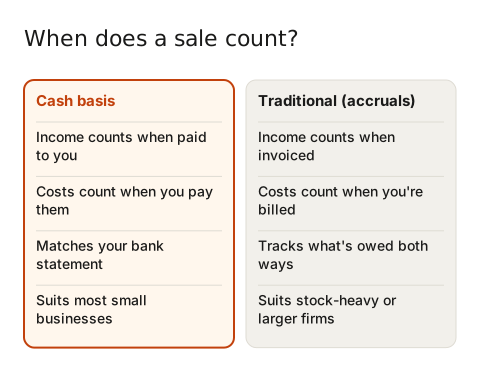
The difference shows up around the end of the tax year. Imagine you invoice a client on 1 April and they pay on 20 April. Under cash basis, that income falls into the new tax year (it was paid after 5 April). Under traditional accounting, it falls into the old one (it was earned before 5 April).
Cash basis is simpler and matches your bank account, especially if you have a separate business account. Traditional accounting can suit businesses with lots of stock, long projects, or that want to borrow and need accounts lenders recognise. The rules on who can use which method, and how losses and interest are treated, have changed before. Check GOV.UK before you choose.
An example
Nadia, a copywriter, uses cash basis. A client is slow to pay a March invoice and pays in May. That income goes on next year's return, matching when the money actually arrived. She never pays tax on money she hasn't received.
Common mistakes
- Mixing methods: counting income when invoiced but costs when paid.
- Switching back and forth without a reason. Pick one and stay consistent.
- Forgetting that equipment is usually handled differently under each method. See Buying equipment.
Your next step: check which method your bookkeeping app or spreadsheet is set to, and make sure it matches what you tell HMRC.