1 min read
Simplified expenses: flat rates vs actual costs
For your car, your home office and living at your premises, HMRC offers flat rates. They're easier to work out, but not always worth more.
In short
Some costs are tricky to split between business and personal use. Simplified expenses let sole traders use HMRC's flat rates instead of working out the exact business share. They cover three things: vehicles, working from home, and living at your business premises (such as a small B&B).
How it works
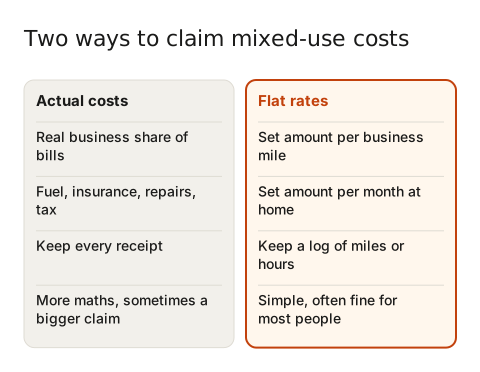
- Vehicles: claim a fixed amount per business mile instead of a share of fuel, insurance, repairs and so on. You still need a mileage log.
- Working from home: claim a flat monthly amount based on the hours you work at home, instead of working out a share of energy bills. Broadband and phone are still claimed separately as normal expenses.
- Living at your premises: deduct a flat amount for personal use from your total premises costs.
There are rules. Once you use the mileage rate for a vehicle, you must keep using it for as long as you use that vehicle in the business. And if you've already claimed capital allowances on a vehicle, you can't switch to the flat rate for it. The rates themselves are reviewed from time to time. Check GOV.UK.
An example
Zoe, a bookkeeper, works from her spare room most days. Working out the exact business share of her gas and electricity would take hours. She uses the flat rate instead and keeps a simple note of hours worked each month. Her claim is smaller than an exact calculation might be, but the time saved is worth it to her.
Common mistakes
- Claiming the mileage rate and fuel costs for the same car.
- Counting your ordinary commute to a regular workplace as business miles.
- Not keeping a log. Flat rates are simple, not evidence-free. See Keeping records.
Your next step: start a mileage and hours log now, even if you haven't decided which method to use. You'll need it either way.