1 min read
Payments on account, explained
Once your tax bill is big enough, HMRC asks you to pay next year's tax in two advance instalments. Here's why the second January can feel so expensive.
In short
Payments on account are advance payments towards next year's tax bill. Each one is normally half of last year's bill. They're due on 31 January and 31 July. Then a final balancing payment settles any difference the following January.
How it works
HMRC assumes this year will look like last year. So once your bill is over a set amount, and you don't already have most of your tax taken through PAYE, you're asked to pay ahead in two halves.
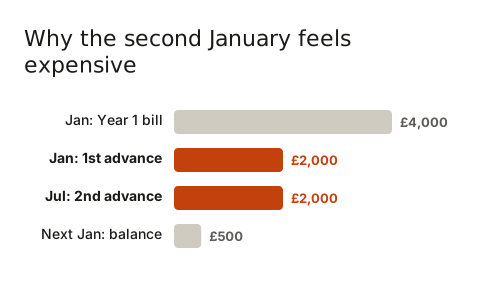
The first time it happens, it stings. On the same January day you pay your whole first-year bill plus the first advance for year two. After that, it settles into a steady rhythm. Each January you pay a balancing payment plus the first advance for the new year, and each July the second advance.
If you know this year's profit will be lower, you can apply to reduce your payments on account. But if you reduce them too far and owe more, you'll pay interest on the shortfall.
An example
Using made-up figures: Lewis's first-year bill is £4,000. In January he pays £4,000 plus £2,000 (half of £4,000) as the first advance. In July he pays another £2,000. His second year's tax comes to £4,500, so the following January he pays a £500 balance, plus the first advance for year three.
Common mistakes
- Not saving for the advance in year one. Build it into your tax pot.
- Forgetting the July payment. It's easy to miss because it isn't linked to a return.
- Reducing payments on account without good reason, then paying interest.
Your next step: if you're in your first year, add half your estimated bill to what you need saved for January. Note 31 July in your calendar.