1 min read
The UK tax year: why it starts on 6 April
The UK's tax year runs from 6 April to 5 April. Knowing which year your income falls in makes every deadline make sense.
In short
In the UK, the tax year runs from 6 April to the following 5 April. Each tax year is named after both calendar years it touches, like '2025 to 2026'. Everything you earn and spend in that window goes on one Self Assessment return.
How it works
The odd start date is a leftover from centuries-old calendar changes, and it has stuck. What matters for you is the rhythm it creates:
- You earn and spend money during the tax year.
- The year ends on 5 April.
- You then have until the following 31 January to file your return online and pay what you owe.
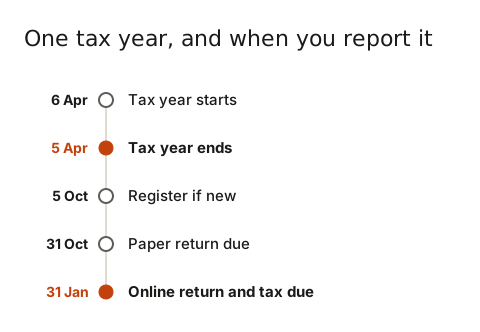
That gap is useful, but it's also a trap. It's easy to spend money in May that you'll owe HMRC the next January. That's why we suggest the tax pot habit.
Your business can also use its own accounting period, but for most sole traders the simplest choice is to match the tax year. Your records then line up with your return automatically.
An example
Amara starts dog-walking in June. Her first tax year runs from that June to the next 5 April. She registers for Self Assessment before 5 October after that tax year ends. She files and pays by 31 January, roughly ten months after the year closed.
Common mistakes
- Mixing up the calendar year and the tax year when totting up income.
- Treating the 31 January deadline as the time to start your records, rather than to finish them. See Keeping records.
- Forgetting that the second year often brings payments on account on top of the bill.
Your next step: put 5 April and 31 January in your calendar as repeating yearly events. Then read The Self Assessment calendar.