1 min read
Allowable expenses and the 'wholly and exclusively' rule
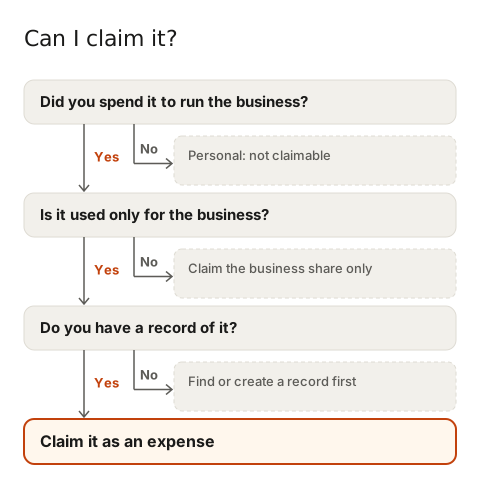
One rule decides most expenses: was it wholly and exclusively for the business? If it was partly personal, claim only the business part.
In short
An allowable expense is a cost you can deduct from your income to reduce your taxable profit. The core test is that it's spent wholly and exclusively for the business. If something is used for both business and personal life, you can usually claim the business part only.
How it works
Typical allowable costs fall into a handful of groups:
- Stock, materials and things you resell.
- Office costs: stationery, phone, broadband, software.
- Travel for business (not your normal commute to a regular workplace).
- Professional fees: accountants, insurance, trade memberships.
- Marketing: website, adverts, business cards.
- Training that updates skills for your current business.
- Equipment and tools. See Buying equipment.
Things that usually aren't allowable: your everyday clothes (even if you wear them to work), fines, entertaining clients, and personal living costs. Uniforms, protective kit and costumes for performers are a different matter.
For costs that are hard to split, like a home office or a car, HMRC offers simplified expenses: flat rates instead of maths.
An example
Mia uses her phone for work about half the time. She claims half of her monthly bill. Her new laptop is used only for her bookkeeping business, so she claims all of it. Her lunch on a normal workday isn't claimable: everyone has to eat.
Common mistakes
- Claiming a full cost that's partly personal.
- Missing legitimate costs because they seem too small.
- Not keeping receipts. If HMRC asks, you'll need to show what you claimed. See Keeping records.
Your next step: list your regular business costs and note the business share of each mixed-use one. Write down how you worked out the split.