1 min read
Sole trader or limited company?
A limited company separates you from your business and can be tax-efficient at higher profits. It also brings more admin, more rules and public accounts.
In short
Most people start as a sole trader because it's free, quick and simple. A limited company is a separate legal 'person' that you own and run. It can offer some protection and, at higher profits, sometimes tax advantages. It also comes with more paperwork and legal duties.
How it works
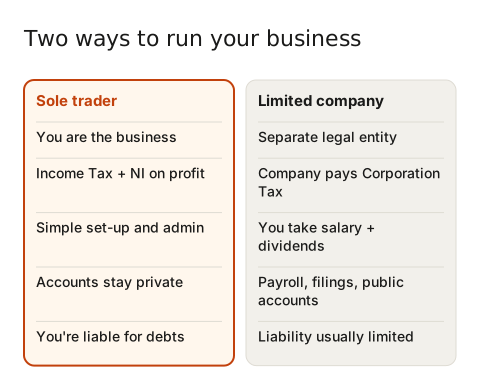
As a sole trader, your profit is your income, taxed through Self Assessment. In a company, the company pays Corporation Tax on its profit. You then take money out as a director's salary (through payroll) and dividends (from profits after tax), each taxed differently.
Things that point towards a company:
- Consistently higher profits, especially more than you need to live on.
- Clients who will only work with companies.
- Business risks you want to keep separate from personal assets. Note: limited liability doesn't protect you from your own negligence or personal guarantees, so insurance still matters.
Things that point towards staying a sole trader: modest profits, wanting minimal admin, and wanting your finances private. Company accounts are public at Companies House. The tax comparison depends on rates that governments change often. It's worth getting advice before switching.
An example
Aisha is a sole trader IT consultant whose profits have grown steadily. Her accountant runs the numbers both ways. Incorporating saves her some tax and suits her larger clients, so she sets up a company. Her friend Pete, a part-time gardener, stays a sole trader: the extra admin would outweigh any saving.
Common mistakes
- Incorporating too early, then paying for accounts and payroll on small profits.
- Treating the company bank account as your own. It isn't your money until it's paid to you.
- Forgetting that pensions can be paid by the company. See Pensions for the self-employed.
Your next step: if your profits are rising, ask an accountant for a side-by-side comparison using your real figures and current rates.