1 min read
VAT schemes in plain English
Flat rate, cash accounting and annual accounting are three HMRC schemes that make VAT simpler for small businesses. Each solves a different problem.
In short
Standard VAT means tracking VAT on every sale and cost and filing regular returns. HMRC offers schemes for smaller businesses. Flat Rate simplifies the maths. Cash Accounting times VAT around when money actually moves. Annual Accounting cuts the number of returns. Some can be combined.
How it works
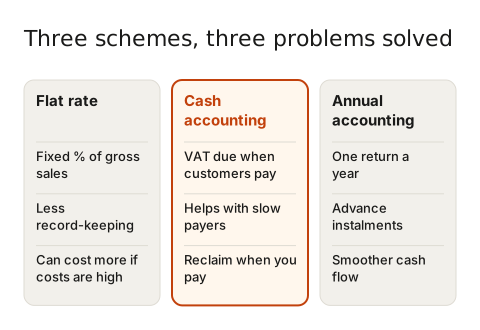
- Flat Rate Scheme: you still charge customers VAT at the normal rate, but you pay HMRC a fixed percentage of your VAT-inclusive turnover. The percentage depends on your type of business. You generally can't reclaim VAT on costs, so it suits businesses with few purchases. There's a special higher rate for businesses that spend very little on goods.
- Cash Accounting Scheme: you pay VAT when your customer pays you, not when you invoice. It protects you from paying VAT on money you haven't received. It's similar in spirit to cash basis for income tax.
- Annual Accounting Scheme: one VAT return a year, with advance payments through the year. It helps budgeting and cash flow.
Each scheme has turnover limits for joining and leaving. They're reviewed from time to time.
An example
Lucy, a consultant, has almost no costs and wants simple admin. The Flat Rate Scheme suits her. Marcus, a builder, buys lots of materials, so he'd lose out on the flat rate. He chooses cash accounting instead, because big clients often pay him late.
Common mistakes
- Joining the flat rate scheme without comparing it to standard VAT using real figures.
- Not checking the limited-cost business rule.
- Forgetting to leave a scheme when you outgrow it.
Your next step: take last quarter's figures and work out the VAT you'd pay under standard VAT and under the flat rate. The difference tells you which suits you.